Everybody knows things are bad. And I don't want to reheat any particular plate of scaremongering hash today. The corporate media has that market cornered. I don’t want to make you my complacent audience. You're already that: look at you. Look at us, glued to our chairs, muscles atrophying into dust. But like Howard Beale, the mad prophet of the airwaves, I’m not going to leave you alone. I want you to get mad.
Monday, June 29, 2009


Saturday, June 27, 2009
Tuesday, June 16, 2009

Monday, June 15, 2009
Book Review: School Shootings
In the course of researching my next novel, I waited for Joseph A. Lieberman’s School Shootings to return to the county library. (God help the poor bastard at Homeland Security charged with cross-indexing my library records—lord only knows what he thinks I’m up to.) And before you ask, no, tonight’s author is not that Joe Lieberman. A journalist and twenty-two year veteran teacher from Boston, this Lieberman spent ten years as a “photojournalist, lecturer and author” in Asia before reentering our Empire in 1999. With Columbine a fresh national trauma, Lieberman set about researching the causes and consequences of such horrific events. His book (originally titled The Shooting Game in its first edition, 2006) is a monumental consequence in itself, a bridge between the sensationalist, bullshit True Crime of an Ann Rule (whom Lieberman quotes) or Charles Patrick Ewing (ditto) and the more-scholarly examinations of this topic, which we’ll examine next time.
Like Ewing, Lieberman provides over three hundred pages of exhaustive, almost exploitative, summaries of real life rampage school shooting events, interspersed with other crimes, such as the more-familiar workplace rampages, which Lieberman attempts to link to the main subject…successfully, for the most part. Throughout, Lieberman charts the lines of correspondence and coincidence you’re bound to find if you stare at any phenomenon long and hard enough. Many an H.P. Lovecraft story revolves around a scholar driven mad by solitary researches into the Abysmal Darkness of subjects just like this. In a modern twist, Lieberman’s own teenage daughter’s school became the site of a gun scare in 2007. No fatalities; the kid went to jail, where he belongs, and the principal even credited Lieberman’s book with helping prevent anything worse from happening.
Lieberman is modest enough to save this story for an epilogue. The bulk of the book revolves around the pathetically tragic story of Kip Kinkel, who killed two and wounded twenty-five on May 21, 1998. Neither the first nor the most infamous soldier in what Lieberman calls “the equivalent of small, personal civil wars fought by a scattering of individuals against their own families, communities and peers,” Kip provides an interesting intersection of banality and insanity. A spree killer, he methodically planned his assault on Thurston High in Springfield, Oregon. Hating society, he killed his parents the day before his rampage, apparently to spare them the social pariahhood suffered by parents of school shooters from Alaska to Arkansas. A nice, normal-seeming boy (when he wasn’t throwing temper tantrums or rocks at cars), Kip reportedly heard voices since the sixth grade. They urged him to kill and constantly reminded him of his status as a piece of human shit, unfit to live, too cowardly to die. He had to kill, in order to be killed. After being tackled by his fellow students (and beaten in the process—photos of his puffy, vacant face, taken the day of the rampage and included half way through the book in true True Crime Book fashion, make this clear) Kip begged to die by their hands. During questioning he pulled a knife on two Springfield police officers and begged for the same. No one obliged, and Kip remains in Salem to this day, waiting for a new trial to come through on appeal.
From Kip, our humble author spirals outward, casting a net wide enough to embrace a seemingly endless stream of incidents, from Charles Whitman’s 1966 Austin, Texas turkey shoot, to Seung-hui Cho’s massacre at Virginia Tech, last year. The gang is, literally, all here, and no one could as for a more exhaustive survey of this topic. All the familiar villains make their appearance, along with plenty of not-so-familiar madman-maniacs from late twentieth century history. Once again we (by which I mean I) meet Brenda Ann Spencer, who opened fire on the elementary school across the street from her house in 1979 because, “I just don’t like Mondays…Nobody likes Mondays.” Once again we see Stephen King’s/Richard Bachman’s Rage blamed for the shootings at Moses Lake, Washington (“Sure beats Algebra class, don’t it?”) and West Paducah, Kentucky. We even meet some of the men who might’ve inspired King to write that book in the first place…like Tony Barbaro, a sort of transitional fossil, who set fire to his school on December 13, 1974, and killed three by sniping at the responding firemen. Or Robert Polin, who shot six people at St. Pius X High School in Ottawa on May 28, 1975. From there we move forward, to the great explosion of 1992—nine incidents in a year when youth violence as a whole spiked higher than a punk’s mohawk—odd Lieberman doesn’t mention that last fact. Odd, too, that there’s no mention of those pesky Los Angeles riots, as if they’re best swept under the rug, like O.J. Simpson.
While its long on evidence and short on conclusions (like most pop-criminology), School Shootings does deliver the proscriptive goods throughout, and Lieberman concludes by advocating the same kind of paranoid lock-down strategies American scholars have seen so much of these last ten years. Explicitly comparing school shooters to Islamic terrorists, Lieberman goes on to suggest school should suffer the same security treatment enjoyed by airports across the country, and the world. Lieberman explicitly rejects any charges of sensationalism (don’t they always?), and he does not restrict his criticism to video games, or the mega-corporations that manufacture them (though he gives credence to that wonderful fantasy-syndrome, video game addiction, inadvertently aiding the military-industrial-pharmaceutical-complex—but then, nobody’s perfect). NRA activists, willfully-blind parents, oblivious school administrators (like the Principal of Columbine High, who denied the existence of any jock-worshiping culture at his school, thank you) and kids who know and do not tell--all get theirs in turn. Lieberman is enough of a journalist to editorialize without turning the book into a polemic, and enough of a writer to cover some of the ugliest topics in American history with sprightly, sparkling prose that commands you read on, even as you’re sickened by “the horror…the horror…”
Indeed—Lieberman advises us not to turn away from the monsters in our midst, while simultaneously remaining suspicious of everyone. And Lieberman does mean everyone. The enemy is very much among us, in a fundamental, Body Snatchers sense. He looks just like us; they’re here already; you’re next, and so we must monitor our children, force them to treat such incidents seriously (as the sign at Sea-Tac said, “It’s No Joke!”), and report them to the proper authorities. The policeman is, after all, your friend, and we are all in this together, part of the homogeneous block of wonderful that is the United States of America, glory be, praise God, world without end, amen. There’s a palpable, fire-eating sense that “we must safeguard our children” running through this book, and I’m sure all the right parents are, even now, in the process of implementing its recommendations.
I pity the children who go to those schools, much as Lieberman does. Echoing Danny Ladonne (creator of Super Columbine Massacre RPG!, who’s documentary, Playing Columbine, I’ll be requesting for my birthday), Lieberman shares with us an email from a former Columbine High student who, two years ago now, wrote the current principal to let him (and us) know that not a damn thing’s changed in ten years. Another shooting, according to this anonymous source, could very well happen at Columbine…and at any time.
And if that isn’t enough fearmongering for one night, brothers and sisters, you should seek professional help. You, like this country, may have a fear addiction. So far, there is no cure.
Leaving aside questions of liberty (which students obviously have to sacrifice in the name of safety) is the American airport really an institution worthy of emulation? Study after study’s concluded that, for all TSA’s posturing and paranoia, airports are no safer today than they were in the 1970s, when you could still show up five minutes before your flight departed with no carry-on luggage, pay for a one-way ticket to the Dubai with cash, and joke your way into the stewardesses’ pants by asking her for a pat-down search. To find your gun. Not the one that’s for shooting; the one that’s for fun.
Schools, for the vast majority of their inmates, are no fun, and as Michael Moore reminded us in Bowling for Columbine, things went from bad to worse in the wake of that fateful April morn. One could just as easily argue that airport-style (I almost wrote “Soviet style”) security measures have only made the problem worse, as the frequency of rampage incidents has remained steady, while body counts have increased, indicating an increasing sophistication on the part of the shooters. Seung-hui Cho made a point of chaining the doors shut before he opened fire at Virginia Tech. The lesser known, post-Columbine, post-9/11 spate of shooters almost to a man (for, despite a chapter titled “The Female of the Species,” women are all-but invisible in this universe of shooters) reference “sainted” Eric Harris and Dylan Klebold, underlining Roger Ebert’s contention that sensationalist media portrayals of these events do more long-term damage than the events themselves. And while I disagree with Lieberman’s conclusions he and I do agree on two important things: these events are not predictable, and they’re not about to stop any time soon.
In the meantime, Mr. Lieberman’s book remains a good one-stop-shop for the discriminating researcher into these incidents. One paradoxically hopes, even as one “enjoys” the book for its merits, that a new edition will prove unnecessary, and that author Lieberman might be permitted to move on to greener pastures. Doubtful, but you never know. Hope does spring eternal.
Like Ewing, Lieberman provides over three hundred pages of exhaustive, almost exploitative, summaries of real life rampage school shooting events, interspersed with other crimes, such as the more-familiar workplace rampages, which Lieberman attempts to link to the main subject…successfully, for the most part. Throughout, Lieberman charts the lines of correspondence and coincidence you’re bound to find if you stare at any phenomenon long and hard enough. Many an H.P. Lovecraft story revolves around a scholar driven mad by solitary researches into the Abysmal Darkness of subjects just like this. In a modern twist, Lieberman’s own teenage daughter’s school became the site of a gun scare in 2007. No fatalities; the kid went to jail, where he belongs, and the principal even credited Lieberman’s book with helping prevent anything worse from happening.
Lieberman is modest enough to save this story for an epilogue. The bulk of the book revolves around the pathetically tragic story of Kip Kinkel, who killed two and wounded twenty-five on May 21, 1998. Neither the first nor the most infamous soldier in what Lieberman calls “the equivalent of small, personal civil wars fought by a scattering of individuals against their own families, communities and peers,” Kip provides an interesting intersection of banality and insanity. A spree killer, he methodically planned his assault on Thurston High in Springfield, Oregon. Hating society, he killed his parents the day before his rampage, apparently to spare them the social pariahhood suffered by parents of school shooters from Alaska to Arkansas. A nice, normal-seeming boy (when he wasn’t throwing temper tantrums or rocks at cars), Kip reportedly heard voices since the sixth grade. They urged him to kill and constantly reminded him of his status as a piece of human shit, unfit to live, too cowardly to die. He had to kill, in order to be killed. After being tackled by his fellow students (and beaten in the process—photos of his puffy, vacant face, taken the day of the rampage and included half way through the book in true True Crime Book fashion, make this clear) Kip begged to die by their hands. During questioning he pulled a knife on two Springfield police officers and begged for the same. No one obliged, and Kip remains in Salem to this day, waiting for a new trial to come through on appeal.
From Kip, our humble author spirals outward, casting a net wide enough to embrace a seemingly endless stream of incidents, from Charles Whitman’s 1966 Austin, Texas turkey shoot, to Seung-hui Cho’s massacre at Virginia Tech, last year. The gang is, literally, all here, and no one could as for a more exhaustive survey of this topic. All the familiar villains make their appearance, along with plenty of not-so-familiar madman-maniacs from late twentieth century history. Once again we (by which I mean I) meet Brenda Ann Spencer, who opened fire on the elementary school across the street from her house in 1979 because, “I just don’t like Mondays…Nobody likes Mondays.” Once again we see Stephen King’s/Richard Bachman’s Rage blamed for the shootings at Moses Lake, Washington (“Sure beats Algebra class, don’t it?”) and West Paducah, Kentucky. We even meet some of the men who might’ve inspired King to write that book in the first place…like Tony Barbaro, a sort of transitional fossil, who set fire to his school on December 13, 1974, and killed three by sniping at the responding firemen. Or Robert Polin, who shot six people at St. Pius X High School in Ottawa on May 28, 1975. From there we move forward, to the great explosion of 1992—nine incidents in a year when youth violence as a whole spiked higher than a punk’s mohawk—odd Lieberman doesn’t mention that last fact. Odd, too, that there’s no mention of those pesky Los Angeles riots, as if they’re best swept under the rug, like O.J. Simpson.
While its long on evidence and short on conclusions (like most pop-criminology), School Shootings does deliver the proscriptive goods throughout, and Lieberman concludes by advocating the same kind of paranoid lock-down strategies American scholars have seen so much of these last ten years. Explicitly comparing school shooters to Islamic terrorists, Lieberman goes on to suggest school should suffer the same security treatment enjoyed by airports across the country, and the world. Lieberman explicitly rejects any charges of sensationalism (don’t they always?), and he does not restrict his criticism to video games, or the mega-corporations that manufacture them (though he gives credence to that wonderful fantasy-syndrome, video game addiction, inadvertently aiding the military-industrial-pharmaceutical-complex—but then, nobody’s perfect). NRA activists, willfully-blind parents, oblivious school administrators (like the Principal of Columbine High, who denied the existence of any jock-worshiping culture at his school, thank you) and kids who know and do not tell--all get theirs in turn. Lieberman is enough of a journalist to editorialize without turning the book into a polemic, and enough of a writer to cover some of the ugliest topics in American history with sprightly, sparkling prose that commands you read on, even as you’re sickened by “the horror…the horror…”
Indeed—Lieberman advises us not to turn away from the monsters in our midst, while simultaneously remaining suspicious of everyone. And Lieberman does mean everyone. The enemy is very much among us, in a fundamental, Body Snatchers sense. He looks just like us; they’re here already; you’re next, and so we must monitor our children, force them to treat such incidents seriously (as the sign at Sea-Tac said, “It’s No Joke!”), and report them to the proper authorities. The policeman is, after all, your friend, and we are all in this together, part of the homogeneous block of wonderful that is the United States of America, glory be, praise God, world without end, amen. There’s a palpable, fire-eating sense that “we must safeguard our children” running through this book, and I’m sure all the right parents are, even now, in the process of implementing its recommendations.
I pity the children who go to those schools, much as Lieberman does. Echoing Danny Ladonne (creator of Super Columbine Massacre RPG!, who’s documentary, Playing Columbine, I’ll be requesting for my birthday), Lieberman shares with us an email from a former Columbine High student who, two years ago now, wrote the current principal to let him (and us) know that not a damn thing’s changed in ten years. Another shooting, according to this anonymous source, could very well happen at Columbine…and at any time.
And if that isn’t enough fearmongering for one night, brothers and sisters, you should seek professional help. You, like this country, may have a fear addiction. So far, there is no cure.
Leaving aside questions of liberty (which students obviously have to sacrifice in the name of safety) is the American airport really an institution worthy of emulation? Study after study’s concluded that, for all TSA’s posturing and paranoia, airports are no safer today than they were in the 1970s, when you could still show up five minutes before your flight departed with no carry-on luggage, pay for a one-way ticket to the Dubai with cash, and joke your way into the stewardesses’ pants by asking her for a pat-down search. To find your gun. Not the one that’s for shooting; the one that’s for fun.
Schools, for the vast majority of their inmates, are no fun, and as Michael Moore reminded us in Bowling for Columbine, things went from bad to worse in the wake of that fateful April morn. One could just as easily argue that airport-style (I almost wrote “Soviet style”) security measures have only made the problem worse, as the frequency of rampage incidents has remained steady, while body counts have increased, indicating an increasing sophistication on the part of the shooters. Seung-hui Cho made a point of chaining the doors shut before he opened fire at Virginia Tech. The lesser known, post-Columbine, post-9/11 spate of shooters almost to a man (for, despite a chapter titled “The Female of the Species,” women are all-but invisible in this universe of shooters) reference “sainted” Eric Harris and Dylan Klebold, underlining Roger Ebert’s contention that sensationalist media portrayals of these events do more long-term damage than the events themselves. And while I disagree with Lieberman’s conclusions he and I do agree on two important things: these events are not predictable, and they’re not about to stop any time soon.
In the meantime, Mr. Lieberman’s book remains a good one-stop-shop for the discriminating researcher into these incidents. One paradoxically hopes, even as one “enjoys” the book for its merits, that a new edition will prove unnecessary, and that author Lieberman might be permitted to move on to greener pastures. Doubtful, but you never know. Hope does spring eternal.
Thursday, June 04, 2009

Saturday, May 23, 2009
Book Review: The Paperback Apocalypse
In the course of researching my next novel (and how I love the fact I don’t have to think up new hooks for these articles) I came across Robert M. Price’s The Paperback Apocalypse, a wonderfully thorough overview of fundamentalist End Times literature. Tim LaHaye and Jerry Jenkins’ Left Behind series is neither the first nor the most interesting entry in the field, which has a long and storied history. Left Behind only did for Apocalypse novels what Straight Outta Compton did for Gangsta Rap, propelling the sub-genre into national prominence. The Paperback Apocalypse functions as a road map through this Tribulation territory, with Mr. Price, a professor of scriptural studies at Johnnie Coleman Theological Seminary, as our ecumenical tour guide.
Our Humble Author doesn’t skimp on this trip, making sure to take the scenic route. We begin with genesis—the god Yahweh’s genesis in the moral power struggle between priests and prophets in fifth century Israel. Once an ass-kicking, plague-bringing, god of kingship and nationhood, Yahweh El Elyon morphed into his more-familiar, judgmental self after the Babylonian Exile. With Israel’s upper classes carted off whole hog, the laypeople were (ahem) left behind to puzzle out what the hell could’ve happened. How could their mighty God desert them so callously?
A quick glance at the lives of the prophets provided what we now call the Deuteronomic answer: Israel and Judah’s sins caused God to withdraw His favor. Surprise: it was all King David’s fault. His Royal Highness’ wandering penis had condemned the whole nation. Even if the priests and kings returned (as they would, relatively soon, with the support of Persia’s self-deifying emperor) it could all happen again the next time someone in high office violated the covenant. Better to believe that, someday soon, God would flex his warrior-king muscles and upend the whole status quo, returning to cast the priests into Gahenna. With God dwelling among them, Israel would become a land of priestly people, with all the world’s pagan kings reduced to servile servants of the restored Temple.
Meanwhile, the returning priestly aristocrats did what aristocrats like to do and cracked down on the people’s ad hoc worship. From Persia they brought with them a view of the world we now call Manichean, though back then it was simply Zoroastrian. A Persian prophet and (alleged) contemporary of Moses, Zoroaster taught that all the world’s a battleground between the forces of Good, represented by the god Ahura Mazada and Evil, represented by the antigod Ahriman. Balanced but not equal, Good would surely win out in the end, but until then every human deed, and every historical event, was a proxy battle in their Great War, its outcome a point for one side or the other.
Put these two beliefs together and you’ve got fertile ground to grow yourself a Revelation. Ground lain, Price devotes chapters two through six to an almost-exhaustive dissection of the modern fundamentalist Apocalypse. “Messianic Prophecy”; “The Gospel of the Anti-Christ”; “The Second Coming”; “The Secret Rapture”; all receive point-by-point, Scriptural refutation from our author, who swings a mighty big theological pipe. Actually, he’s Dr. Price, a fact I had to find on the Internet, despite his receiving the degree (in systematic theology from Drew University) twenty-six years before writing this book. Do I smell false modesty? Or is Dr. Price preemptively dodging the anti-intellectual arrows fundamentalists so-love to throw at anyone who questions their beliefs?
Price confesses a personal interest in Apocalyptic literature (calling it a “guilty pleasure” the same words we around this corner of the internet use to defend our love for Bad Movies) but never once mentions his own falling-out with fundamentalism. This isn’t about him; it’s about the indefensibility of modern fundamentalist beliefs. Price (rightly) identifies the “faith” of the Rapture Ready as a collection of half-baked misinterpretations, compounded by willful ignorance of the very Bible they claim to idolize. Like a certain Golden Calf I know, their doctrine breaks under the weight of all these scriptural quotations, from Isaiah to Revelations, which Price helpfully restores to their historical and cultural context, something beyond the keen your average, jumped-up, Southern Baptist.
With a firm grounding in the genre’s “classics,” Price jumps to the early twentieth century, and the first End Times novels. Given the fundamentalist condemnation of novel-reading as a sinful, worldly pursuit—like drinking, whoring, and card playing—its no surprise the first real entry in the genre comes in 1905, with Joseph Birbeck Burroughs’ Titan, Son of Saturn: The Coming World Emperor - A Story of the Other Christ. Now if that’s not a rip-roaring, full-throated, modernist title, I don’t know what is. Can’t you just picture Henry James off to the side, clucking his tongue at it?
From thence we move straight on ‘til morning—past Left Behind (which, fittingly, receives its own chapter at the very end) and right up to more-modern, less-successful, and (believe it or not) less-well-written entries in the genre. Raise your hand if you’ve heard of Hal Lindsey’s Blood Moon. Or William A. Stanmeyer’s Catholic-toned Day of Iniquity: A Prophetic Novel of the End Times. Or James BeauSeigneur’s Christ Clone Trilogy. Or Pat Robertson’s own entry, The End of the Age.
If you have, by now you’re probably pretty pissed at my flippant dismissal of your faith. (I invite you to utilize the Comments button below, and please don’t hesitate to describe the yawning torments of hell awaiting me in the Next World.) If you haven’t heard of these books you probably don’t care, except in an academic sense—marveling at the genre from a distance. Like most speculative fiction (call it “mainstream” as Price does when he reviews "mainstream" Apocalypse novels, like The Stand), fundamentalist End Times novels are the center of a multibillion dollar, international media industry, with more published every year. More, certainly, than anyone could read in a lifetime devoted to the subject.
Thankfully, Dr. Price reads these things for fun, and presents this book as a gift to us. Half-Biblical exegesis, half-book review anthology, The Paperback Apocalypse is just the ticket if you’d like a superficial knowledge of the genre and a thorough knowledge of how to refute its theological underpinnings. Unlike Dr. Price, I make no bones about my personal stake in both projects.
Our Humble Author doesn’t skimp on this trip, making sure to take the scenic route. We begin with genesis—the god Yahweh’s genesis in the moral power struggle between priests and prophets in fifth century Israel. Once an ass-kicking, plague-bringing, god of kingship and nationhood, Yahweh El Elyon morphed into his more-familiar, judgmental self after the Babylonian Exile. With Israel’s upper classes carted off whole hog, the laypeople were (ahem) left behind to puzzle out what the hell could’ve happened. How could their mighty God desert them so callously?
A quick glance at the lives of the prophets provided what we now call the Deuteronomic answer: Israel and Judah’s sins caused God to withdraw His favor. Surprise: it was all King David’s fault. His Royal Highness’ wandering penis had condemned the whole nation. Even if the priests and kings returned (as they would, relatively soon, with the support of Persia’s self-deifying emperor) it could all happen again the next time someone in high office violated the covenant. Better to believe that, someday soon, God would flex his warrior-king muscles and upend the whole status quo, returning to cast the priests into Gahenna. With God dwelling among them, Israel would become a land of priestly people, with all the world’s pagan kings reduced to servile servants of the restored Temple.
Meanwhile, the returning priestly aristocrats did what aristocrats like to do and cracked down on the people’s ad hoc worship. From Persia they brought with them a view of the world we now call Manichean, though back then it was simply Zoroastrian. A Persian prophet and (alleged) contemporary of Moses, Zoroaster taught that all the world’s a battleground between the forces of Good, represented by the god Ahura Mazada and Evil, represented by the antigod Ahriman. Balanced but not equal, Good would surely win out in the end, but until then every human deed, and every historical event, was a proxy battle in their Great War, its outcome a point for one side or the other.
Put these two beliefs together and you’ve got fertile ground to grow yourself a Revelation. Ground lain, Price devotes chapters two through six to an almost-exhaustive dissection of the modern fundamentalist Apocalypse. “Messianic Prophecy”; “The Gospel of the Anti-Christ”; “The Second Coming”; “The Secret Rapture”; all receive point-by-point, Scriptural refutation from our author, who swings a mighty big theological pipe. Actually, he’s Dr. Price, a fact I had to find on the Internet, despite his receiving the degree (in systematic theology from Drew University) twenty-six years before writing this book. Do I smell false modesty? Or is Dr. Price preemptively dodging the anti-intellectual arrows fundamentalists so-love to throw at anyone who questions their beliefs?
Price confesses a personal interest in Apocalyptic literature (calling it a “guilty pleasure” the same words we around this corner of the internet use to defend our love for Bad Movies) but never once mentions his own falling-out with fundamentalism. This isn’t about him; it’s about the indefensibility of modern fundamentalist beliefs. Price (rightly) identifies the “faith” of the Rapture Ready as a collection of half-baked misinterpretations, compounded by willful ignorance of the very Bible they claim to idolize. Like a certain Golden Calf I know, their doctrine breaks under the weight of all these scriptural quotations, from Isaiah to Revelations, which Price helpfully restores to their historical and cultural context, something beyond the keen your average, jumped-up, Southern Baptist.
With a firm grounding in the genre’s “classics,” Price jumps to the early twentieth century, and the first End Times novels. Given the fundamentalist condemnation of novel-reading as a sinful, worldly pursuit—like drinking, whoring, and card playing—its no surprise the first real entry in the genre comes in 1905, with Joseph Birbeck Burroughs’ Titan, Son of Saturn: The Coming World Emperor - A Story of the Other Christ. Now if that’s not a rip-roaring, full-throated, modernist title, I don’t know what is. Can’t you just picture Henry James off to the side, clucking his tongue at it?
From thence we move straight on ‘til morning—past Left Behind (which, fittingly, receives its own chapter at the very end) and right up to more-modern, less-successful, and (believe it or not) less-well-written entries in the genre. Raise your hand if you’ve heard of Hal Lindsey’s Blood Moon. Or William A. Stanmeyer’s Catholic-toned Day of Iniquity: A Prophetic Novel of the End Times. Or James BeauSeigneur’s Christ Clone Trilogy. Or Pat Robertson’s own entry, The End of the Age.
If you have, by now you’re probably pretty pissed at my flippant dismissal of your faith. (I invite you to utilize the Comments button below, and please don’t hesitate to describe the yawning torments of hell awaiting me in the Next World.) If you haven’t heard of these books you probably don’t care, except in an academic sense—marveling at the genre from a distance. Like most speculative fiction (call it “mainstream” as Price does when he reviews "mainstream" Apocalypse novels, like The Stand), fundamentalist End Times novels are the center of a multibillion dollar, international media industry, with more published every year. More, certainly, than anyone could read in a lifetime devoted to the subject.
Thankfully, Dr. Price reads these things for fun, and presents this book as a gift to us. Half-Biblical exegesis, half-book review anthology, The Paperback Apocalypse is just the ticket if you’d like a superficial knowledge of the genre and a thorough knowledge of how to refute its theological underpinnings. Unlike Dr. Price, I make no bones about my personal stake in both projects.
Sunday, May 17, 2009
Thursday, May 07, 2009
New Review
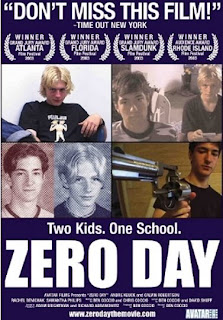
Though I missed the true anniversary of Columbine (April 20th--ten years baby), I offer up this review of Zero Day as my own private observance.
Wednesday, May 06, 2009
Morning News
And now the news. It must be Wednesday.
First, a headline that speaks for itself, so much so you won't see anything like it on this side of the pond: U.S. air strikes kill dozens of Afghan civilians.
And while we're at it, here's an article from last year which vindicates decades of American culture warrior paranoia. Turns out I've been wrong all these years and violent video dogames inspire violence in children...provided those children join the military.
There's a lot of messy connective tissue running between these two articles. Neither acknowledges the fact that, as war becomes more depersonalized, with cause further and further removed from consequence, we're going to have to get used to these civilian casualties. In a strange way we already are. We deny them (literally: see last August's raid on the village of Azizabad) but, since we supplied them, that only make sense. Our military's had a long, tawdry love affair with "strategic" bombing, consummated during World War II. Either we'll continue to shut our eyes to true cost of this poisonous, codependent relationship, or at last reach a point where we can no longer put up with with the overwhelming amounts of bullshit involved.
We are, as a nation, not quite there yet. We'll see how long it takes this "Long War" (oh, I'm sorry, "Overseas Contingency Operation") to break through our national self-denial.
Last note: Minion of the Long War by C.G. Estabrook.
First, a headline that speaks for itself, so much so you won't see anything like it on this side of the pond: U.S. air strikes kill dozens of Afghan civilians.
The police chief Watandar said Taliban guerrillas had herded civilians into houses in the villages of Geraani and Ganj Abad, and these places were then struck by war planes. "The fighting was going on in another village, but the Taliban escaped to these two villages, where they used people as human shields. The air strikes killed about 120 civilians and destroyed 17 houses," he said, admitting, however, that the death toll was imprecise.
And while we're at it, here's an article from last year which vindicates decades of American culture warrior paranoia. Turns out I've been wrong all these years and violent video dogames inspire violence in children...provided those children join the military.
Fancy yourself as a tasty videogamer? [That's what my girlfriend tells me.--D] Then you might soon want to pursue a career in the army. Joypad dexterity, that most 21st-century of skills, is poised to assume a key role on the battlegrounds of Afghanistan and Iraq, now that defense contractor Raytheon has announced plans to use videogame technology in its unmanned aerial vehicles (UAVs), or drones.
There's a lot of messy connective tissue running between these two articles. Neither acknowledges the fact that, as war becomes more depersonalized, with cause further and further removed from consequence, we're going to have to get used to these civilian casualties. In a strange way we already are. We deny them (literally: see last August's raid on the village of Azizabad) but, since we supplied them, that only make sense. Our military's had a long, tawdry love affair with "strategic" bombing, consummated during World War II. Either we'll continue to shut our eyes to true cost of this poisonous, codependent relationship, or at last reach a point where we can no longer put up with with the overwhelming amounts of bullshit involved.
We are, as a nation, not quite there yet. We'll see how long it takes this "Long War" (oh, I'm sorry, "Overseas Contingency Operation") to break through our national self-denial.
Last note: Minion of the Long War by C.G. Estabrook.
Sunday, May 03, 2009
As the World Burns (And Encouraging Message of Hope from Your Humble Narrator)
Much as I despise the American Empire, I live here too, in the heart of a major American city I’d just as soon not see reduced to a cloud of ash.
Yet it is inevitable. Someone, at some point, will acquire the Bomb and use it, a fact previous generations understood. Visions of nuclear apocalypse are less popular now, with the Cold War a distant memory and the Terror War fast receding into the black hole at the heart of American national memory. Still, they do have their own, sick utility, insomuch as they inspire personal, national and international efforts to put the genii back in the bottle. A foolish dream, perhaps, and hard to hold in an era where non-martial dreams are ridiculed and despised, but it’s mine, nevertheless.
Others dream of phantom enemies. In a report released two weeks ago, as open, armed conflict resumed across northern Pakistan, David Albright—that is Dr David Albright, president and founder of the Institute for Science and International Security—warned “the public” (which, according to my handy English-to-Think Thank-ese dictionary, means “Congress”) that “the security of any nuclear material” produced by Pakistan’s ever-increasing number of nuclear reactors “is in question.”
It’s not enough that al Qaeda-allied crazy folks are sixty miles from the capital. It’s not enough that the Pakistani military is, even now, bombing the northwestern portions of its own country back into the Precambrian Age. It’s not enough that this violence has displaced millions, killed thousands, and enraged untold multitudes who won’t hesitate for a moment to join up with the next charismatic asshat who comes riding over the mountainous border, intent on recruiting fresh martyrs to the cause. No. They have to have dirty bombs, too.
From The Power of Nightmares:
Yet it is inevitable. Someone, at some point, will acquire the Bomb and use it, a fact previous generations understood. Visions of nuclear apocalypse are less popular now, with the Cold War a distant memory and the Terror War fast receding into the black hole at the heart of American national memory. Still, they do have their own, sick utility, insomuch as they inspire personal, national and international efforts to put the genii back in the bottle. A foolish dream, perhaps, and hard to hold in an era where non-martial dreams are ridiculed and despised, but it’s mine, nevertheless.
Others dream of phantom enemies. In a report released two weeks ago, as open, armed conflict resumed across northern Pakistan, David Albright—that is Dr David Albright, president and founder of the Institute for Science and International Security—warned “the public” (which, according to my handy English-to-Think Thank-ese dictionary, means “Congress”) that “the security of any nuclear material” produced by Pakistan’s ever-increasing number of nuclear reactors “is in question.”
It’s not enough that al Qaeda-allied crazy folks are sixty miles from the capital. It’s not enough that the Pakistani military is, even now, bombing the northwestern portions of its own country back into the Precambrian Age. It’s not enough that this violence has displaced millions, killed thousands, and enraged untold multitudes who won’t hesitate for a moment to join up with the next charismatic asshat who comes riding over the mountainous border, intent on recruiting fresh martyrs to the cause. No. They have to have dirty bombs, too.
From The Power of Nightmares:
Saturday, May 02, 2009
Book Review: Kids Who Kill by Charles Patrick Ewing
I’m toying with the idea of turning this blog into research journal for the last two months, rolling it around in my mind the way you’d roll an unwanted interloper in feathers after dousing him with honey, or hot tar. The old injunction, “Write what you know,” is a challenge, not a straightjacket. The implicit corollary, “Learn more and you’ll be able to write more,” is my engine, driving a lifetime of education in subjects most schools would rather not touch. Like school shaootings.
In the course of researching my next novel (which is one of those wonderful sentences writers get to write, the kind that just glow at you) I’ve learned a lot about school shootings. Except that’s not exactly accurate. I’ve remembered a good ninety-eight percent of the more memorable stuff, since it began right around the time I began to pay attention to the world outside the bounds of my small, Midwestern town. The ten-year anniversary of Columbine (which I allowed to pass unnoticed) helped me tremendously in this. Time magazine even resurrected it’s deliciously sensationalist article on the subject from December, 1999, reheating the case’s particular blend of hash.
The Portland Community College library provided me two not-so-excellent books on the subject this week. Published ten years apart, they nicely bookend that extraordinary heyday of youth-perpetrated violence still blithely refer to as, “the 90s.”
One end, Charles Patrick Ewing’s Kids Who Kill, rests in 1989. Despite the copyright date (1990), Kids Who Kill is an unabashed product of the 1980s, filled with lucid accounts of heinous “juvenile” crimes, subdivided into chapter-length categories. Its chapter titles read like prime time, news-magazine show bumpers: “Family Killings,” “Senseless Killings,” “Cult-Related Killings,” “Gang Killings,” “Little Kids Who Kill,” and my personal favorite, the nebulous “Crazy Killings.”
Author Ewing is an all-but-invisible presence through all this, filling each chapter with capsule descriptions of theme-specific cases, drawn from the best mainstream media sources of his time: the Boston Globe, the Chicago Tribune, UPI, the New York and Los Angeles Times. A source citation page totally devoid of web addresses is a strange artifact to find, from another, alien time…much like the book itself. Ewing’s tone is equally foreign to those of us on the other side of the great Faux News divide. After a decade and a half of personalized news, delivered unto us by news personalities (celebrity anchors, talking heads, snakeoil information salesmen, pundits), Ewing’s case studies seem fleeting, callous, bite sized examinations of events that garner round-the-clock, team coverage these days, and passed unnoticed in a world just coming to grips with the end of the Cold War and the dawning of our current New World Order. A typical entry, chosen at random, reads like the ticker at the bottom of your TV screen.
Another example:
And so long as I’ve Fair Use on my side, have one more:
One hundred seventy pages of this is enough to make you take a bite out of capital-C, Crime, whilst simultaneously saying, "No" to the drugs and fantasy role playing games that are destroying our nation’s youth.
If the past is another country, writers must be anthropologists. A good anthropologist will take heed of a culture’s fears and superstitions. Kids Who Kill suggests that a peculiar fear of youth slumbers at the heart of our culture, occasionally rearing its head to freeze us with a Cobra gaze straight out of Rudyard Kipling. It rose up in 1990, and again in 1999, events building upon themselves, sprouting intertwining threads of correspondence and coincidence.
None of which has anything to do with Kids Who Kill, which is a strange, haunting little book that, in its final pages, suggests four commonsensical “known factors” common to killer kid cases: “child abuse, poverty, substance abuse, and access to guns.” School shooters of the now-familiar type (spree-killing monsters in black coats stuffed full of weapons) lying downstream from Ewing in the course of history, go unexamined. History responds in kind by refusing to vindicate the dire predictions Ewing puts forth in lieu of conclusion in his final chapter, “Juvenile Crime in the 1990s.”
There, Ewing predicts that juvenile homicides will reach “record high proportions” by the year 2000, ignorant of the fact juvenile homicide as a whole would peak in the recession years of 1992-3, years of riot and tumult, when American nonchalantly joked about being broke. (A bit like now, come to think about it…) Ewing leaves himself little time to flesh out his “known factors” or do anything more than refer back to a few previously described cases by way of illustration. There’s little analysis here (besides a few tables), and no discernible political agenda. When this book saw print the culture wars that drive (and define) today’s non-fiction publishing industry were barely a glimmer in Rush Limbaugh’s eye. If our wider, societal obsession with vicarious violence bares any blame for creating killer kids, Ewing does not say. Instead, he reminds us that Ronald Regan’s eight year “war on the poor” sure as shit didn’t help. Matter of fact (Ewing says, in his own detached, Joe-Friday, just-the-facts-ma’am way), Reganomics did plenty to exacerbate the four “known factors,” factors ignored and/or exacerbated by the then-current administration of George (HW) Bush.
Busy building a New World Order, America would go on to largely ignore Ewing’s slim little book, or its dire warnings for the future. Each of his four “known factors” remained in operation, resurfacing ten years later in the Great Explosion of school shooting and killer kid literature of 1996-9…some of which we’ll turn to next time, as our research into this negative image of the American dream continues.
Note: Special thanks to Anonymous for catching my Freudian slip involving the author's name. I was thinking of earwigs.
In the course of researching my next novel (which is one of those wonderful sentences writers get to write, the kind that just glow at you) I’ve learned a lot about school shootings. Except that’s not exactly accurate. I’ve remembered a good ninety-eight percent of the more memorable stuff, since it began right around the time I began to pay attention to the world outside the bounds of my small, Midwestern town. The ten-year anniversary of Columbine (which I allowed to pass unnoticed) helped me tremendously in this. Time magazine even resurrected it’s deliciously sensationalist article on the subject from December, 1999, reheating the case’s particular blend of hash.
The Portland Community College library provided me two not-so-excellent books on the subject this week. Published ten years apart, they nicely bookend that extraordinary heyday of youth-perpetrated violence still blithely refer to as, “the 90s.”
One end, Charles Patrick Ewing’s Kids Who Kill, rests in 1989. Despite the copyright date (1990), Kids Who Kill is an unabashed product of the 1980s, filled with lucid accounts of heinous “juvenile” crimes, subdivided into chapter-length categories. Its chapter titles read like prime time, news-magazine show bumpers: “Family Killings,” “Senseless Killings,” “Cult-Related Killings,” “Gang Killings,” “Little Kids Who Kill,” and my personal favorite, the nebulous “Crazy Killings.”
Author Ewing is an all-but-invisible presence through all this, filling each chapter with capsule descriptions of theme-specific cases, drawn from the best mainstream media sources of his time: the Boston Globe, the Chicago Tribune, UPI, the New York and Los Angeles Times. A source citation page totally devoid of web addresses is a strange artifact to find, from another, alien time…much like the book itself. Ewing’s tone is equally foreign to those of us on the other side of the great Faux News divide. After a decade and a half of personalized news, delivered unto us by news personalities (celebrity anchors, talking heads, snakeoil information salesmen, pundits), Ewing’s case studies seem fleeting, callous, bite sized examinations of events that garner round-the-clock, team coverage these days, and passed unnoticed in a world just coming to grips with the end of the Cold War and the dawning of our current New World Order. A typical entry, chosen at random, reads like the ticker at the bottom of your TV screen.
[F]our New Jersey youths—members of a much larger, self-proclaimed group of “Dotbusters”—beat a thirty-year-old Indian man to death in a city street. According to the police, these “Dotbusters”—who took their name from the red bindi mark worn on the foreheads of married Indian women—were responsible for numerous violent attacks against Indian and Pakistani immigrants. The youths in this particular case, who ranged in age from fifteen to seventeen, denied any racial motive for their brutal attack. Instead, they insisted that they attacked the Indian man because he was bald. Though charged with murder, they were convicted only of assault.
Another example:
On July 10, 1989 a fourteen-year-old Chicago mother was trying to watch television. After being interrupted several times by her one-month-old son who would not stop crying, the girl smothered the infant with a disposable diaper. The teenager was charged with murder, but a judge ruled that given her “previously clean record” she would not be tried as an adult.
And so long as I’ve Fair Use on my side, have one more:
In January 1988, seventeen-year-old Leslie Torres, a homeless New York City youth, went on a seven day “cocaine-inspired rampage”—a spree of armed robberies in which he killed five people and wounded six others. When arrested, Leslie told police that he committed numerous killings and robberies to support his $500-a-day addiction to the street drug [sic], crack. Charged with murder, he pleaded not guilty by reason of insanity.
Testifying on his own behalf, Leslie told jurors that crack caused him to eel like God, but that he saw the Devil whenever he looked in the mirror. After examining Leslie, a psychiatrist testified that the teenager suffered from “cocaine induced psychosis” at the time o the robberies and killings. The jury rejected Leslie’s insanity defense and convicted him of murder. Finding that the seventeen-year-old “showed utter and total disregard for the sanctity of life” and “would kill again” if ever released, a judged sentenced Leslie Torres to sixty years to life in prison.
One hundred seventy pages of this is enough to make you take a bite out of capital-C, Crime, whilst simultaneously saying, "No" to the drugs and fantasy role playing games that are destroying our nation’s youth.
If the past is another country, writers must be anthropologists. A good anthropologist will take heed of a culture’s fears and superstitions. Kids Who Kill suggests that a peculiar fear of youth slumbers at the heart of our culture, occasionally rearing its head to freeze us with a Cobra gaze straight out of Rudyard Kipling. It rose up in 1990, and again in 1999, events building upon themselves, sprouting intertwining threads of correspondence and coincidence.
None of which has anything to do with Kids Who Kill, which is a strange, haunting little book that, in its final pages, suggests four commonsensical “known factors” common to killer kid cases: “child abuse, poverty, substance abuse, and access to guns.” School shooters of the now-familiar type (spree-killing monsters in black coats stuffed full of weapons) lying downstream from Ewing in the course of history, go unexamined. History responds in kind by refusing to vindicate the dire predictions Ewing puts forth in lieu of conclusion in his final chapter, “Juvenile Crime in the 1990s.”
There, Ewing predicts that juvenile homicides will reach “record high proportions” by the year 2000, ignorant of the fact juvenile homicide as a whole would peak in the recession years of 1992-3, years of riot and tumult, when American nonchalantly joked about being broke. (A bit like now, come to think about it…) Ewing leaves himself little time to flesh out his “known factors” or do anything more than refer back to a few previously described cases by way of illustration. There’s little analysis here (besides a few tables), and no discernible political agenda. When this book saw print the culture wars that drive (and define) today’s non-fiction publishing industry were barely a glimmer in Rush Limbaugh’s eye. If our wider, societal obsession with vicarious violence bares any blame for creating killer kids, Ewing does not say. Instead, he reminds us that Ronald Regan’s eight year “war on the poor” sure as shit didn’t help. Matter of fact (Ewing says, in his own detached, Joe-Friday, just-the-facts-ma’am way), Reganomics did plenty to exacerbate the four “known factors,” factors ignored and/or exacerbated by the then-current administration of George (HW) Bush.
Busy building a New World Order, America would go on to largely ignore Ewing’s slim little book, or its dire warnings for the future. Each of his four “known factors” remained in operation, resurfacing ten years later in the Great Explosion of school shooting and killer kid literature of 1996-9…some of which we’ll turn to next time, as our research into this negative image of the American dream continues.
Note: Special thanks to Anonymous for catching my Freudian slip involving the author's name. I was thinking of earwigs.
Wednesday, April 15, 2009
Saturday, March 07, 2009
Godzilla the Series: An Exercise in Over-Analysis (Part VIII)
Episode 9 - Hive
 On the vaguely-Pacific island of Santa Marta, a species of enormous, animate plant disturbs a band of youthful-looking looters, come to scavenge the island’s hastily-evacuated luxury resort.
 The tropical resort provides a nice twist on the usually-monotonous Jungle Fight…though I always hate how easy it is for giant monster movie makers to lose perspective in natural settings. The tendency is to film (or animate) at your creature’s eye level, as once again our human heroes flee, leaving the volcano to clean up after Godzilla.

 On the vaguely-Pacific island of Santa Marta, a species of enormous, animate plant disturbs a band of youthful-looking looters, come to scavenge the island’s hastily-evacuated luxury resort.
H.E.A.T. arrives after the credits, and team lead Nick Tatopolus is quick to claim the moral high ground. “We’re not just here on their word,” meaning the looters. “The resort company also asked us to check it out.” The increasingly-annoying Randy, for once, delivers some useful information with his follow-up quip. “And he asked in the universal language: moolah.” We know now that H.E.A.T., like the Ghostbusters before them, work on spec, no doubt offering “Professional megafauna investigation and elimination.” Or “innovative, giant monster removal solutions.”
Whatever the case, an underwater thermal geyser spills Our Heroes onto the beach, wreaking their trusty inflatable motor raft. While Nick and Randy hotwire it, Craven, Elsie and Monique carve a path inland through the surprisingly lush foliage between beach and resort. Don’t volcanic eruptions tend to thin out jungles? And what’s Elsie talking about “underground nuclear tests” back in the 50s? This whole set-up spells BAD in big, blinking letters and you’d think someone (Nick, say?) would suggest staying together, at least until the boat’s fixed. But no. Our team splits up. “Something inside the ash,” Elsie theorizes as they truck on, “must be acting as a super fertilizer.” Who died and made you Team Botanist, Doctor? Weren’t you a paleontologist a few episodes ago? Or are you just talking to fight the heeby-geebies? At least Mendel gives into them honestly; “Help me! Their alive,” he shouts, accidentally falling into a tangle of vines.
 At the hotel, French Fry and Cowardly Scientist find plenty of vicious vines. Retreating into the hotel, they also find a hive-full of pick-up truck-sized bees. Monique breaks an ankle evading them and still manages to keep Mendel alive. Her disdain is palpably French as they flee into the hotel’s ventilation system.
 Now, let’s talk about fluctuating superpowers. About Superman turning back time by flying around the world. About He-Man holding starships in place with some magic lasso She-Ra stole from Wonder Woman. About Aquaman, cira Superfriends, and his glass jaw. About many a Decepticon taken out with one punch. I’m talking about Godzilla being unable to wrench himself free from a bushel of triffids. Why? So Nick and Randy can rig up a laser on site out of whatever they’ve got in their backpacks. Times like this, I wonder about Dr. Nick; he could be MacGuyver in disguise, befriended by a giant reptile. If so, I wish he’d hurry up and tell Godzilla to crush Nightrider.
 Laser-equipped, Nick and Randy stand by at minimum safe distance and watch Godzilla trim the verge. And just when the series has lost me, it wins me back: a giant bee descends from the sky to snatch Randy away. Can I hope for the slow, painful death of this show’ s Odieus Comic Relief? There’s no real harm in that…is there?
No. Because you’ll remember the hive, which consumes most of the hotel. Nevertheless, Mendel and Monique (through sheer cartoon luck) happen to come out of the vents in the Queen’s Throneroom—formerly an Olympic sized swimming pool. Her Majesty needs all the space she can get though. Like so many cartoon monsters in this pre-digital age, Her Majesty will radically change size and proportion throughout the fight scene to come. As will Godzilla, who arrives to wreak havoc on the beehive, along with the hotel it just so happens to occupy.
 Since we know H.E.A.T. works on a pay-for-play basis, I’d love to see someone try to deduct collateral damage to their assets out of Dr. Nick’s quoted price. Does Nicky start low or play high ball? He does seem to have the giant monster hunter market cornered, but how long will that last? Where’s the South Pacific’s answer to this shifty bunch of gaijin? (In a future episode, that’s where.) Where’s the army? Assuming there were underground nuclear tests “in the 50s,” what’s to say the Go’ment gave up its stake in this little bit of radioactive paradise? Maybe the whole “resort company” thing is a front—like Monique’s “casualty and property insurance” business.
 Elsie gets captured by giant vines…who don’t seem to do much beyond grab you and pull you above the treeline. Nick rescuers her with his new laser, and you can tell the boys in marketing really wanted to paint Nick as an Action Hero. Not only does he rescue the redheaded damsel with his handmade (rather Ghostbuster-like) blaster, he gets to catch her in his arms, a nerdy Fabio impersonator straight from a Harlequin Romance cover…if, that is, small armies of underpaid South Korean animators drew Harlequin Romance covers.
 Godzilla’s neigh-invulnerability comes to the fore here, as the Big-G at last gets a decent fight scene under him. After the wrestling matches with El Gusano and the Orange, Candy-Striped Ooze, Godzilla’s had a run of low budget opponents. Not so with the Queen Bee or her hive of Killers. Having already survived the ocean’s depths and the U.S. military (who so-handedly dispatched the “first” Godzilla in 1998’s movie…which I really should get around to reviewing here at some point or another), Randy’s “Lizard King,” (no, honey, that’s Jim Morrison) survives a lot of crap in this episode. Bee stings, volcanic eruptions, hazardous falls, Randy’s one-liners…this Godzilla could give the Tick lessons in poise, and it’s nice to see…even if it does shoot any dramatic tension this show had left in the head. No, not the foot; the head.
 The tropical resort provides a nice twist on the usually-monotonous Jungle Fight…though I always hate how easy it is for giant monster movie makers to lose perspective in natural settings. The tendency is to film (or animate) at your creature’s eye level, as once again our human heroes flee, leaving the volcano to clean up after Godzilla.
Clean up it does, wiping out the whole island in the tradition of Godzilla vs the Sea Monster. Godzilla survives, of course, to Nick’s evident delight. So, despite some weak spots in the middle, and the usual complaints, a good monster time is had by all. This is the most “traditional” episode so far, sharing its setting, plot-structure, and resolution with many an SF film “from the 50s.” I could rattle of a whole baker’s dozen of them (and those are just the ones that end with a spontaneous volcanic eruption). But then again, if you’re reading these words, chances are you can too.

Sunday, March 01, 2009
Subscribe to:
Posts (Atom)